1929 | Black Thursday

Black Thursday in America, Black Friday in Europe is a term for 24 October 1929 and the associated most momentous stock market crash in history. This stock market crash is considered to have triggered the Great Depression in the USA and the world economic crisis. The following bear market only reached its final low point in 1932.

History

On 24 October, the stock market opened 11% below the previous day’s level. To stem the panic, various institutions and financiers intervened with bids above the market price, so that the losses on that day were still modest. On the following Friday, share prices even recovered slightly.

The recovery was short-lived, however, as on 28 October 1929, known as “Black Monday”, the Dow Jones Industrial Average finished 13.47% lower, ending the day at 260.64 points on the index. The next day, known as “Black Tuesday”, the stock market fell another 11.73% to 230.07 points. Panicked investors sold a total of 16,410,030 shares.

This was preceded by a speculative bubble. In the 1920s, a seemingly unstoppable bull market had driven the Dow Jones up to 331 points – in 1923 it was still at around 100. There was talk of “Eternal Prosperity”. In this misjudgement of the situation, not only large investors and companies speculated, but also numerous small investors risked a lot; millions took out large short-term loans to buy shares (often the shares alone were considered collateral) in the hope of being able to pay them back with the profits. A stock exchange supervisory authority and many laws on regulation that are taken for granted today did not exist at that time.

There were warnings in advance, which were dismissed as doom and gloom. The majority of business leaders and economists were still convinced in mid-October that the highs would continue forever. For example, economics professor Irving Fisher was still proclaiming on 16 October: “It looks like stocks have reached a permanent plateau”. When the Dow Jones lost significantly in October 1929, nervousness broke out: It dawned on many how much of a risk they had taken. By 19 October, the Dow Jones had lost 15%; banks and investment firms began to buy in support.

Causes

The cause of the bear market is said to be the monetary tightening that the US Federal Reserve began in 1935. Put simply, the Fed had raised interest rates too soon after the Great Depression.

Ray Dalio, the manager of the world’s largest hedge fund Bridgewater Associates, wrote about this in an article of 18 May 2015 for Business Insider that the Fed raised interest rates eight years after the 1929 crisis following an accommodative monetary policy to stimulate the economy, which Ray Dalio believes was still too early.

  1. At the peak of the stock market bubble, the debt ceiling was reached, which also marked the peak of the economy (1929)
  2. In the midst of the depression, interest rates fell to zero (1931)
  3. The Fed cranks up the printing press and initiates a deleveraging (1933)
  4. Stock markets then began a rally (1933-1936)
  5. During a cyclical recovery, the economy also improved (1933-1936)
  6. The central bank tightens monetary policy, leading to a self-reinforcing downturn (1935)

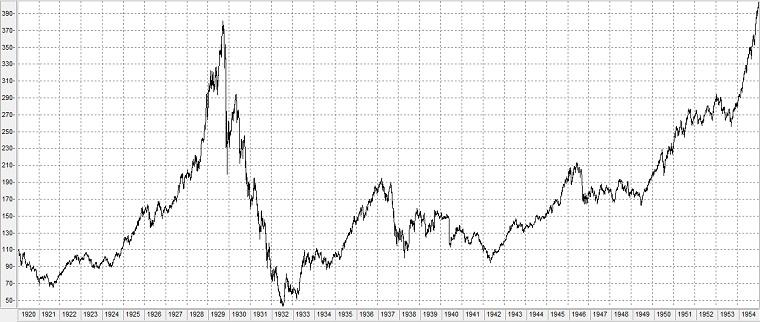
Development of the DIJA from January 1920 to December 1954
Progression of the crisis

3. September 1929

Der Dow Jones Index erreicht seinen Höhepunkt und schließt bei 381,17 Punkten.

19. Oktober 1929

Der Dow Jones Index verliert bis zum 15. Oktober 15%.

28. Oktober 1929

Der Dow Jones Index geht um 13,47% niedriger aus dem Handel und bendet den Tag bei 260,64 Punkten.

29. Oktober 1929

Der Dow Jones Index fällt um weitere 11,73% auf 230,07 Punkte.

Sommer 1932

Der Dow Jones Index erreicht seinen Höhepunkt und schließt bei 381,17 Punkten.

It was not until 23 November 1954 that the Dow Jones Industrial Average reached its previous high of 381.17 points. It thus took a full 25 years for the price declines from the stock market crash of 1929 to be fully recovered.

The consequences for the economy - world economic crisis

The stock market crash and the subsequent world economic crisis, which lasted until 1939, affected almost all social classes and changed the perspective and the relationship of an entire generation to the financial markets.

The so-called “Golden Twenties” with their great optimism, high consumption and strong economic growth now tipped over into the exact opposite – a phase of pessimism and flagging economic growth.

The stock market crash of 1929 cannot be considered the sole cause of the Great Depression, but it did accelerate the collapse of the world economy. By 1933, almost half of America’s banks had failed and nearly 15 million people – about 30% of the former workforce – slid into unemployment.

The government under President Franklin D. Roosevelt (1882-1945) helped to reduce the worst effects of the Great Depression. However, the US economy did not fully recover until after 1939, when World War II revived American industry.

Consequences

From the experience of Black Thursday, all stock exchanges later enacted rules that temporarily suspended trading in the event of an extreme fall in prices in order to curb any panic that might arise. In addition, there were further restrictions, for example on the credit financing of share transactions. Subsequent stock market crashes were therefore less dramatic than Black Thursday.

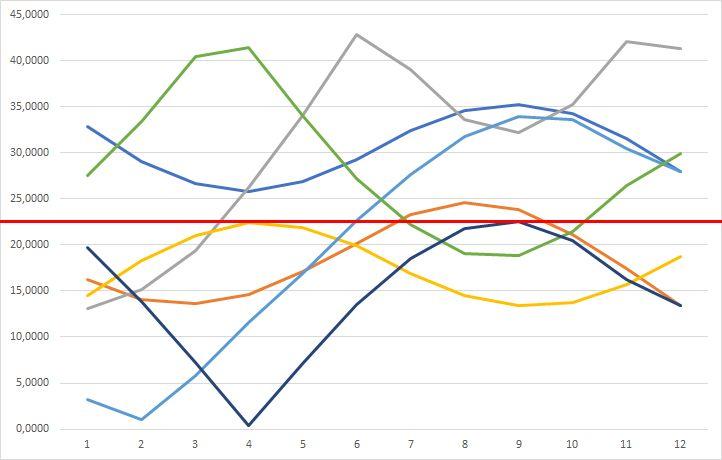
Comparison previous year / crisis year

7 Medium-term fractal indicators - 1928
7 Medium-term fractal indicators - 1929
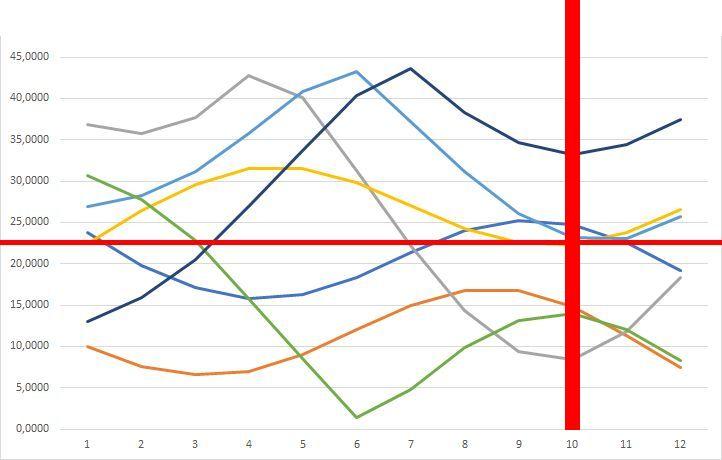
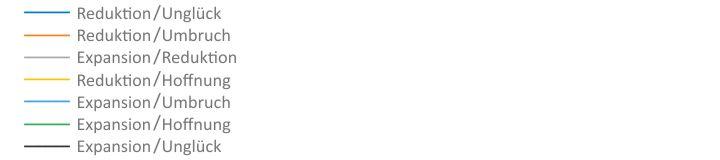
Chart legend for the seven medium-term fractal indicators
Bull and Bear

Devaluation is the reduction of the nominal exchange rate of one’s own currency against foreign currencies when quoted in quantity. The opposite is revaluation.

-> Wikipedia

The Dow Jones Industrial Average (DJIA) – also known as the Dow Jones Index in Europe – is one of several stock indices created by the founders of the Wall Street Journal and the Dow Jones company, Charles Dow (1851-1902) and Edward Jones (1856-1920), in 1884.

Charles Dow compiled the index to measure the performance of the US stock market. The Dow Jones Index on the New York Stock Exchange (NYSE) is the oldest stock index still in existence in the USA after the Dow Jones Transportation Average and today is made up of 30 of the largest US companies.

-> Wikipedia

The Federal Reserve System, often called the Federal Reserve or simply the Fed (as the US Federal Reserve), is the central banking system of the United States.

-> Wikipedia

In the stock market, the word bull market (or bull market [os]; French for rise, increase) stands for persistently rising stock market prices, whereas bear market (or bear market [bɛs]; French for decline, decrease) stands for persistently falling prices. A “stock market cycle” comprises a bull market and a bear market.

-> Wikipedia

Hedge funds are actively managed investment funds in the financial sector whose business purpose is to make alternative investments and which therefore take on higher financial risks than classic investment funds.

-> Wikipedia

The S&P 500 (Standard & Poor’s 500) is a stock index comprising the shares of 500 of the largest listed US companies. The S&P 500 is weighted by market capitalisation and is one of the most widely followed stock indices in the world.

-> Wikipedia

The New Deal was a series of programs, pubIic work projects, financial reforms, and regulations enacted by President Franklin D. Roosevelt in the United States between 1933 and 1939.

-> Wikipedia

Legal Notice

Amend Finance

Represented by:

Prof. Dr. Udo Amend

Responsible for content according to § 55 para. 2 RStV:

Prof. Dr. Udo Amend

Oberacher 1

CH-6315 Morgarten

Email: ud******@*mx.de

Disclaimer:

Liability for content

The content of our pages was created with the greatest care. However, we cannot accept any liability for the accuracy, completeness and timeliness of the content. As a service provider, we are responsible for our own content on these pages in accordance with § 7 para. 1 DDG. However, according to §§ 8 to 10 DDG, as a service provider, we are not obliged to monitor submitted or stored third-party information or to search for circumstances that indicate illegal activity. Obligations to remove or block the use of information in accordance with general laws remain unaffected. In this case, liability is only possible at the time of knowledge about a specific violation of law. If we become aware of any such violations of law, we will remove this content immediately.

Liability for links

Our offer contains links to external third-party websites over whose content we have no influence. We therefore cannot accept any liability for this external content. The respective provider or operator of the site is always responsible for the content of the linked pages. The linked pages were checked for possible violations of law at the time of linking. Illegal content was not recognizable at the time of linking. However, permanent control of the content of the linked pages is not reasonable without concrete evidence of a violation of law. If we become aware of any violations of law, we will remove such links immediately.

Copyright

The content and works on these pages created by the site operators are subject to German copyright law. Duplication, processing, distribution and any type of exploitation outside the limits of copyright law require the written consent of the respective author or creator. Downloads and copies of this page are only permitted for private, non-commercial use. Insofar as the content on this page was not created by the operator, the copyrights of third parties are observed. In particular, third-party content is marked as such. Should you nevertheless become aware of a copyright infringement, we ask you to inform us accordingly. If we become aware of any infringements, we will remove such content immediately.


Data protection

Using our website is generally possible without providing personal data. If personal data (such as name, address or email addresses) is collected on our pages, this is always done on a voluntary basis wherever possible. This data will not be passed on to third parties without your express consent. We would like to point out that data transmission on the Internet (e.g. when communicating by email) can have security gaps. Complete protection of data against access by third parties is not possible. The use of contact data published as part of the imprint obligation by third parties to send unsolicited advertising and information materials is hereby expressly prohibited. The operators of the pages expressly reserve the right to take legal action in the event of unsolicited advertising information being sent, for example through spam emails.

Google Analytics

This website uses Google Analytics, a web analysis service provided by Google Inc. (“Google”). Google Analytics uses so-called “cookies”, text files that are stored on your computer and that enable an analysis of your use of the website. The information generated by the cookie about your use of this website (including your IP address) is transmitted to a Google server in the USA and stored there. Google will use this information to evaluate your use of the website, to compile reports on website activity for website operators and to provide other services related to website activity and internet usage. Google may also transfer this information to third parties where required to do so by law, or where third parties process this data on Google’s behalf. Google will never associate your IP address with other Google data. You can prevent the installation of cookies by setting your browser software accordingly; however, we would like to point out that in this case you may not be able to use all functions of this website to their full extent. By using this website, you consent to the processing of data about you by Google in the manner and for the purposes set out above.

Google AdSense

This website uses Google Adsense, a web advertising service provided by Google Inc., USA (“Google”). Google Adsense uses so-called “cookies” (text files) that are stored on your computer and that enable an analysis of your use of the website. Google Adsense also uses so-called “web beacons” (small invisible graphics) to collect information. By using the web beacon, simple actions such as visitor traffic on the website can be recorded and collected. The information generated by the cookie and/or web beacon about your use of this website (including your IP address) is transmitted to a Google server in the USA and stored there. Google will use this information to evaluate your use of the website in relation to the advertisements, to compile reports on website activity and advertisements for website operators and to provide other services relating to website activity and internet usage. Google may also transfer this information to third parties where required to do so by law, or where third parties process the data on Google’s behalf. Google will never associate your IP address with other Google data. You can prevent cookies from being saved on your hard disk and web beacons from being displayed by selecting “Do not accept cookies” in your browser settings (in MS Internet Explorer under “Tools > Internet Options > Privacy > Settings”; in Firefox under “Tools > Settings > Privacy > Cookies”); however, please note that if you do this you may not be able to use the full functionality of this website. By using this website you consent to the processing of data about you by Google in the manner and for the purposes set out above.

Legal Notice

Amend Finance

Represented by:

Prof. Dr. Udo Amend

Responsible for content according to § 55 para. 2 RStV:

Prof. Dr. Udo Amend

Oberacher 1

CH-6315 Morgarten

Email: ud******@*mx.de

Disclaimer:

Liability for content

The content of our pages was created with the greatest care. However, we cannot accept any liability for the accuracy, completeness and timeliness of the content. As a service provider, we are responsible for our own content on these pages in accordance with § 7 para. 1 DDG. However, according to §§ 8 to 10 DDG, as a service provider, we are not obliged to monitor submitted or stored third-party information or to search for circumstances that indicate illegal activity. Obligations to remove or block the use of information in accordance with general laws remain unaffected. In this case, liability is only possible at the time of knowledge about a specific violation of law. If we become aware of any such violations of law, we will remove this content immediately.

Liability for links

Our offer contains links to external third-party websites over whose content we have no influence. We therefore cannot accept any liability for this external content. The respective provider or operator of the site is always responsible for the content of the linked pages. The linked pages were checked for possible violations of law at the time of linking. Illegal content was not recognizable at the time of linking. However, permanent control of the content of the linked pages is not reasonable without concrete evidence of a violation of law. If we become aware of any violations of law, we will remove such links immediately.

Copyright

The content and works on these pages created by the site operators are subject to German copyright law. Duplication, processing, distribution and any type of exploitation outside the limits of copyright law require the written consent of the respective author or creator. Downloads and copies of this page are only permitted for private, non-commercial use. Insofar as the content on this page was not created by the operator, the copyrights of third parties are observed. In particular, third-party content is marked as such. Should you nevertheless become aware of a copyright infringement, we ask you to inform us accordingly. If we become aware of any infringements, we will remove such content immediately.


Data protection

Using our website is generally possible without providing personal data. If personal data (such as name, address or email addresses) is collected on our pages, this is always done on a voluntary basis wherever possible. This data will not be passed on to third parties without your express consent. We would like to point out that data transmission on the Internet (e.g. when communicating by email) can have security gaps. Complete protection of data against access by third parties is not possible. The use of contact data published as part of the imprint obligation by third parties to send unsolicited advertising and information materials is hereby expressly prohibited. The operators of the pages expressly reserve the right to take legal action in the event of unsolicited advertising information being sent, for example through spam emails.

Google Analytics

This website uses Google Analytics, a web analysis service provided by Google Inc. (“Google”). Google Analytics uses so-called “cookies”, text files that are stored on your computer and that enable an analysis of your use of the website. The information generated by the cookie about your use of this website (including your IP address) is transmitted to a Google server in the USA and stored there. Google will use this information to evaluate your use of the website, to compile reports on website activity for website operators and to provide other services related to website activity and internet usage. Google may also transfer this information to third parties where required to do so by law, or where third parties process this data on Google’s behalf. Google will never associate your IP address with other Google data. You can prevent the installation of cookies by setting your browser software accordingly; however, we would like to point out that in this case you may not be able to use all functions of this website to their full extent. By using this website, you consent to the processing of data about you by Google in the manner and for the purposes set out above.

Google AdSense

This website uses Google Adsense, a web advertising service provided by Google Inc., USA (“Google”). Google Adsense uses so-called “cookies” (text files) that are stored on your computer and that enable an analysis of your use of the website. Google Adsense also uses so-called “web beacons” (small invisible graphics) to collect information. By using the web beacon, simple actions such as visitor traffic on the website can be recorded and collected. The information generated by the cookie and/or web beacon about your use of this website (including your IP address) is transmitted to a Google server in the USA and stored there. Google will use this information to evaluate your use of the website in relation to the advertisements, to compile reports on website activity and advertisements for website operators and to provide other services relating to website activity and internet usage. Google may also transfer this information to third parties where required to do so by law, or where third parties process the data on Google’s behalf. Google will never associate your IP address with other Google data. You can prevent cookies from being saved on your hard disk and web beacons from being displayed by selecting “Do not accept cookies” in your browser settings (in MS Internet Explorer under “Tools > Internet Options > Privacy > Settings”; in Firefox under “Tools > Settings > Privacy > Cookies”); however, please note that if you do this you may not be able to use the full functionality of this website. By using this website you consent to the processing of data about you by Google in the manner and for the purposes set out above.